

In which Anna and Judith travel back to the dark and worrying world of 1930s’ London. Expect purpose-driven publishing, bold marketing and a rousing rebel song.
Will a horrified publisher, desperate to prevent an impending war, find a way to get vital information to the masses?
Connect with Anna & Judith
Find more information and images at the Bookshapers website.
Follow Bookshapers on Instagram.
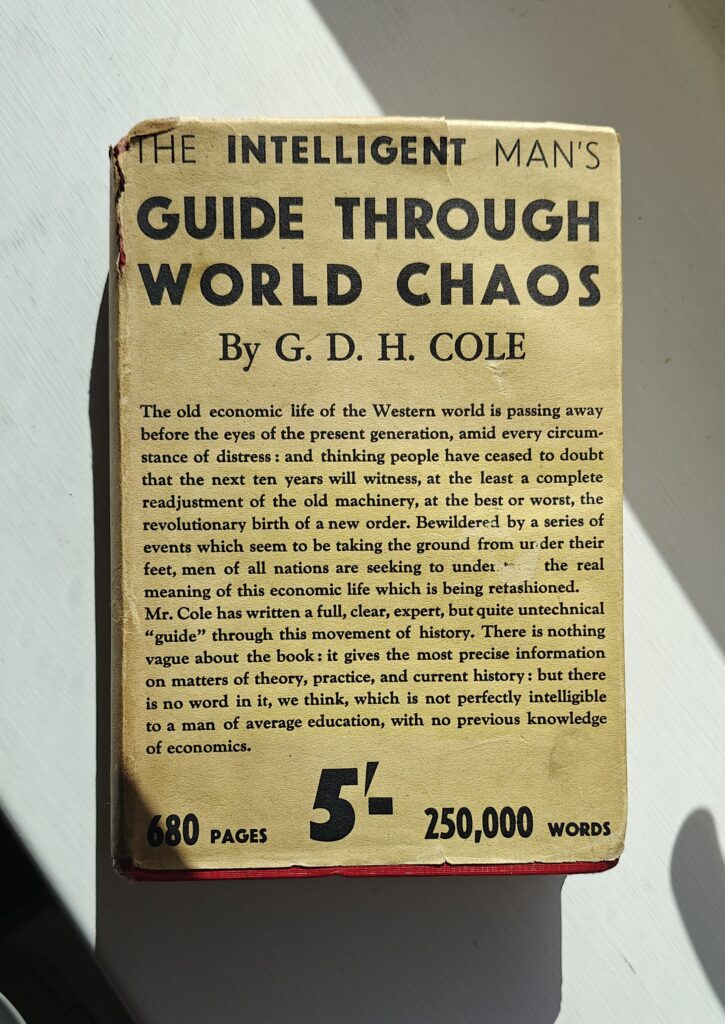
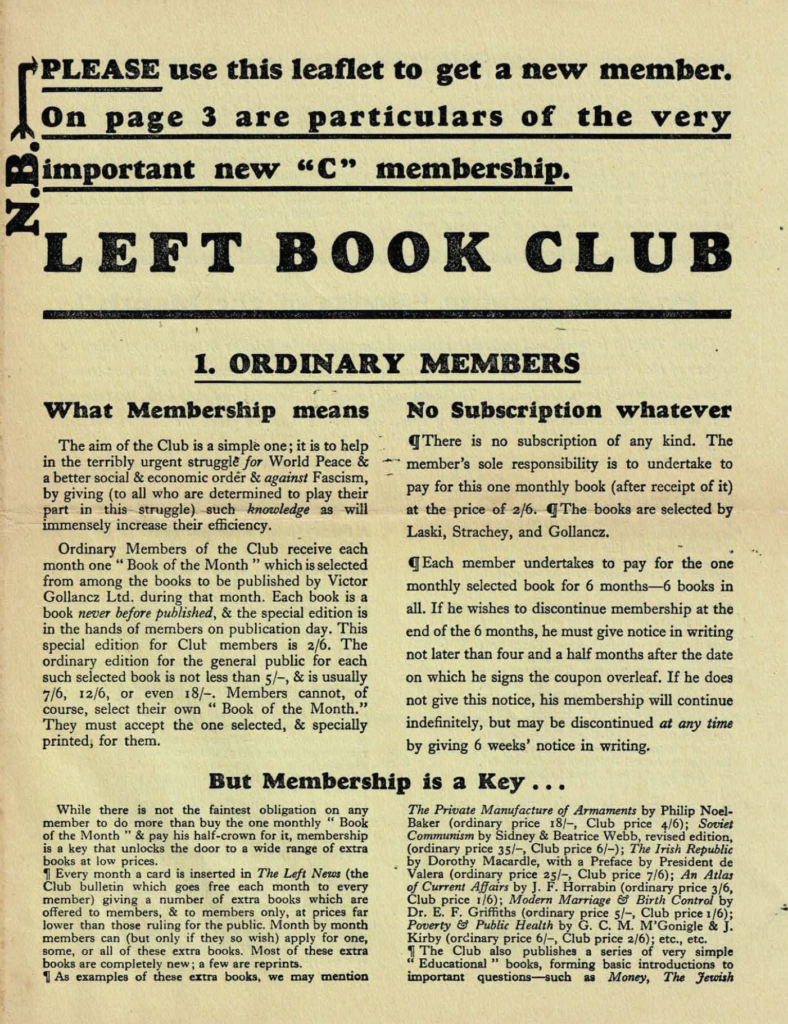
The book and leaflet we discuss during the show
Recorded by Anna Faherty and Judith Watts. Edited and produced by Anna Faherty.
Incidental music: Whirlwinds of Danger by Randall Swingler and Varshav Vyankar from Lansbury’s Labour Weekly recordings in 1926 (available at Bishopsgate Library) and The Internationale by Pierre de Geyter, performed in 1934 by Aage Nielsens Orkester (available at the Internet Archive).
Sound effects: The sound of the typewriter from tams_kp on freeounds.org
Theme music: Folk guitar music track from Dvideoguy on freesound.org | Typewriter sound effect from tams_kp on freeounds.org | Print shop sound effect from ecfike on freesound.org
Introduction
They say the pen is mightier than the sword, but when you’re on the brink of war, can words and books really make a difference? One passionate publisher thought so. Distracting, disturbing and dangerous, the same might be said of you, Judith.
Well, I would like that, but it’s actually committing to something, the idea of the height of the letter. I think sometimes we’ve just got to make those letters really, really big.
Welcome to Bookshapers, the show that explores curious stories about the people and technology behind what we read. This episode, Victor Gollanczz and the Left Book Club. I’m Anna Faherty.
And I’m Judith Watts.
We’re both publishers and writers, and we both share a nerdy fascination for the fine print of how books are written, made, marketed and read.
Anna
For this episode, we find ourselves in 1933, in London. And it’s an interesting time for me, since it’s the year and city where my mother was born.
Judith
And pre-war.
Anna
Just about. Britain’s in the Great Slump, also known as the Great Depression, and the terrors of the earlier war are a relatively recent memory.
You, Judith, are a 39-year-old publisher. You live in Ladbroke Grove with your wife and daughters, and you have two major preoccupations. Firstly, you have a fear of poverty.
Judith
My own? I’m a publisher….
Anna
I think more a fear of poverty in the world and the consequences of that.
And secondly, thanks to a scarring experience with a picture book when you were just six years old, you have a lifelong horror of war.
Judith
Oh, now I’m intrigued.
Anna
You looked at pictures of the Crimean War in a picture book when you were six years old, and since that point, you’ve thought how horrific war is and how it shouldn’t be allowed to happen.
Judith
Wow.
Anna
With that in mind, imagine the scene when one morning in January 1933, you open the Times newspaper and read that the leader of the Nazi party, Adolf Hitler, has been appointed Chancellor of Germany.
There’s no question war is coming. You’re desperate to prevent it, and you’re overtaken with what you describe later as maddened feverishness.
So, Judith, in your maddened feverishness, what are you going to do?
Judith
Well, I’m a publisher, so I am going to fast-track a book or books that are going to make people aware of what’s happening.
I don’t know, maybe I’ll take up… I can’t really take up arms myself.
I don’t know. I don’t know.
Anna
Well, you’re actually on a similar track to our publisher. He later said, “I asked myself, what little could I do? And I answered, you can help enlighten people. You can show them that if capitalism persists, this sort of crisis is inevitable and the final result will be war.”
And in particular, he felt he could help address an urgent need for three things: for clear thinking, for scientific economic analysis, and for radical political thinking.
Judith
Which is quite impressive because there’s not a lot of that around necessarily.
Anna
Well, clearly there wasn’t a lot of it around in the 1930s, but you might say, almost 100 years later, that there’s not a lot of it around today.
It’s worth saying that our publisher had a track record in this kind of educational mission because a couple of decades before, he had taught at Repton, a boys’ boarding school in Derbyshire, where he was, he said, “flabbergasted” to discover that the pupils were “smug”, “superior”, and he says, “grotesquely ignorant” of the world outside.
Judith
In Derbyshire?
Anna
In Derbyshire. But it was a boarding school, so they weren’t necessarily from Derbyshire.
Judith
No, true.
Anna
They were probably from the home counties and had been sent there by their very rich middle-class parents.
Judith
But I am very interested in teacher turned publisher because that’s quite unusual.
Anna
Yeah, so he was very driven to change the views of these boys and he didn’t wholly blame them for this grotesque ignorance. He felt they’d simply accepted what they’d been fed and that what they’d been fed was “poison”. So he decided “to talk politics to these boys and to any others I could get hold of day in and day out”.
Judith
Wow. Impressive.
Anna
Yes. And he set up a weekly class outside of normal class times to tackle the great issues and movements of the day. It became very popular.
Judith
Almost like a debating society?
Anna
Yes, kind of. He’d been a member of the debating society at his own school and at university, so that probably inspired him.
And it sounds like a harmless enough idea, but the boys became a little too fanatical. There was bullying and our publisher-to-be got sacked.
Judith
Yes, I can imagine that happening today as well.
Anna
Despite the outcome, I think it’s clear even at that stage, he was quite young then, that he had a skill for sort of whipping up enthusiasm. And in my research about him, the terms that struck me most were words like passionate, brilliant, magnetic, electric, exuberant, evangelical. One person even calls him Messianic, like he was some sort of shiny saviour that people just felt compelled to follow.
Judith
Well, that’s an interesting list of adjectives for someone. And actually, I like that they’re applied to a publisher.
Anna
Yeah, I mean, I don’t think any of those things are a bad quality for a publisher.
Judith
No, I think they’re great.
Anna
So perhaps it isn’t a surprise that after he was sacked, he resolved to, as he put it, slide into political publishing. A bit like sliding into someone’s DMs.
He had to work in a couple of non-publishing jobs first, but then he got a job at the publisher Ernest Benn. There, he ignored the magazine business he was supposed to be working on, but made a big impression with books. And during his seven years at Benn, he issued dozens of non-fiction paperbacks written by first-rate authorities, like a sort of earlier version of Penguin’s Pelicans, the blue-spined paperbacks that we see in charity shops all over today.
But in 1928, after making his name a bit at Ernest Benn, he set up his own company under his own name. Do you have any guesses who he might be?
Judith
Is it Victor Gollancz?
Anna
It is Victor Gollancz! Very good. I don’t think I would have known that from that description because I’m less versed in the history of publishing, but you clearly know something about Victor. Tell me what you know about Victor.
Judith
I know because I have used him as a case study at different times. So I know when he became the eponymous Gollancz, it was the science fiction lists. That was one of the first science fiction lists.
And there’s still the imprint going today.
Anna
I thought you were going to say that all his books had yellow covers.
Judith
Yes!
Anna
So for listeners who aren’t familiar, Victor Gollancz was very well known for issuing books with these bright yellow covers.
But his company, although, as you say, was kind of known ultimately for science fiction, he began by publishing novels, readable histories, biographies, and detective stories.
But what’s the point in having your own publishing company if you can’t pursue your own passion? So clearly his idea about trying to educate the masses came out in his publishing.
And he wrote later, “it was political publishing that I thought about night and day”, and it didn’t take him long to pump out what he describes as “a great mass” of informative books. And they were long. They were low priced. They were designed, in his words, “to convert people to socialism and pacifism”.
Judith
Wow. They’re very idealistic.
Anna
And I’ve got an example of one of Victor’s long, cheap, informative books here. Let’s take a look at it.
Judith
Excellent.
Anna
Tell us what it’s called, Judith.
Judith
Oh, well, it’s called the ‘Intelligent’, and intelligent is in bold, ‘The Intelligent Man’s Guide Through World Chaos’. Fabulous title.
Anna
Yeah, so it was known in the trade as ‘Cole’s Chaos’ because it’s by GDH Cole, which sounds a bit like a great name for a song or an album. How would you describe the book you’re holding in your hands now?
Judith
It’s fascinating to look at. But interestingly, it’s actually got blurb on the front. So it’s actually describing something quite dramatic before you even open the book. So “the old economic life of the Western world is passing away before the eyes of the present generation”. And then it goes on.
It’s five shillings. It’s 680 pages. And I love that, because it’s got the price and it’s got the word count prominently on the front cover.
Anna
How many words has it got?
Judith
250,000 words! So you’re really getting a lot for your money here.
Anna
Yeah, I should say to listeners, I’m looking at the book that Judith’s holding and it looks like a brick. I mean, it’s big and thick.
Judith
It does look like a brick. It’s got at least almost two inches of spine.
Anna
I love this section here. Maybe you could read it, Judith?
Judith
“Mr. Cole has written a full, clear, expert, but quite untechnical guide through this movement of history. There is nothing vague about the book. It gives the most precise information on matters of theory, practise and current history. There is no word in it, we think, which is not perfectly intelligible to the man of average education, with no previous knowledge of economics.”
Anna
So I think that sums up what Victor was trying to achieve with all these kind of books, that he’d make them accessible to everyone. But the fact that that’s written on the cover in such an overt way… We wouldn’t write that kind of thing on the front of the cover anymore, would we? And we wouldn’t also have the publisher saying, “we think this”. We’d normally now use a reviewer to say that.
Judith
I mean, unless it’s something totally quirky like, you know, ‘The Dummies Guide to…’. But this actually makes you feel, “I could tackle this”. This is a book that just tells you there and then what it is. And I admire them for that.
Anna
So in Victor’s words, it’s a “vast tome full of facts and figures”. He says he published it in an “enormous edition at a ludicrously low price”. And as you said, it’s five shillings. That’s about 15 pounds today. So pretty cheap for a 700-page hardback by an acknowledged authority.
Judith
What I really like about these books is that they’re not pretending almost that books are different than this rare, precious sort of gem. It contains ideas, like it might contain glue or something that’s really, really useful and practical. And, or, you know, even if it’s fiction, that it will take you somewhere and do something when you open it up.
And it’s just almost like it is a product. But age has meant it this beautiful…
Anna
Yeah, and that book that you’re holding there is almost 100 years old, which seems bizarre to me, but…
Judith
And now it is an aesthetic object. It’s beautiful to look at.
Anna
So a publisher pursuing their passion doesn’t always lead to commercial success.
Judith
No, it’s risky business.
Anna
Yes, but Victor really wanted his books to sell. That enthusiasm to convert people meant he wanted them to be in people’s hands. And he was a real innovator when it came to copywriting, advertising and business.
He wouldn’t like me saying that because according to Sheila Hodges, who worked for Gollancz and wrote the company’s history, being called a good businessman was the greatest insult anyone could offer him. So sorry, Victor, for flagging your business nous.
Judith
So that’s why I use that as a case study sometimes with students, because it’s one of the first marketing, branding… all the yellow covers.
Anna
They are bright yellow, but more importantly, Victor used his dust jackets, as we’ve seen with the blurb on that book, as sales and marketing tools. And that was both a new and impactful approach at the time.
Judith
Yes, he presumably did that for all his books. Yeah, it’s a great thing.
Anna
So he engaged typographer Stanley Morrison, also known for designing the font Times New Roman, to develop a striking typographical design for the covers. And Morrison wanted the covers to turn, he says, “the spectator into a reader” and “the reader into a buyer”. He knew a cover needed to draw in unwilling readers, and he aimed, he said, to “drag them into perusal by every sort of typographical seduction”.
Judith
And actually it works. I mentioned straight away the bold in the title, and it is typographical, but it is interesting, whereas we’d be so used to having a visual image. But the words themselves kind of pull you in here.
Anna
Absolutely. And so obviously he achieved the seduction by, we can see, going bold. He made the title and author’s name prominent, he made the content and purpose of the book explicit, and he worked hard to get the reader to turn to the inside flap.
He used multiple fonts, which he printed in black and bright red, resulting in designs that by today’s standards, I would say, can feel a little bit chaotic, but were no doubt striking at the time.
And as for the colour yellow, Victor personally went off to London’s train stations to look at all their bookstores, and from his research, he decided that yellow was the most effective cover colour, and the chosen paper with the splendid name ‘Morgan’s Yellow Radiant’ was sourced from Germany. How would you sum up the covers overall?
Judith
Really, well, now they’re a real tonic. They are striking. Yeah, they’re very appealing.
Anna
Fellow typographer Herbert Jones thought Morrison played with words as if they were toys on his covers, and he says that Morrison made a conscious effort to catch the reader’s roving eye by arranging words “distractingly, disturbingly, dangerously almost”. Distracting, disturbing, and dangerous. The same might be said of you, Judith.
Judith
Well, I would like that, and I would like that on the front of a cover of a book.
Anna
So we probably wouldn’t say it was dangerous what he was doing, but because it hadn’t been done before, it seems like this really out there kind of approach.
Judith
It’s actually committing to something. It’s unapologetic. It’s really a strong message, and I love the idea of playing with words on the cover.
Just really kind of makes you think how important this is.
Anna
Victor also filled entire double-page newspaper spreads with similarly bold typography, and he went to plenty of other great lengths to promote his books. So when Daphne du Maurier’s Gothic novel ‘My Cousin Rachel’ received a good review in the Evening Standard newspaper, Victor sent his Covent Garden staff off to buy 3,000 copies of the paper. He gave everyone in the office a red pen and made them underline key extracts, and then the annotated reviews were in the post later that day, headed for thousands of booksellers in the UK and overseas.
Judith
Genius marketer. He was fabulous. I mean, publicist, marketer, as well as publisher and passionate person.
Anna
Yes, I mean, I think we talk a lot in that kind of era of Allen Lane and his kind of innovation in terms of Penguin and Penguin paperbacks, but I do think he’s as much an innovator in a different vein.
Judith
Just that whole idea of making the most of the publicity and the reviews and connecting immediately. What a character to be in the office handing out the red pens!
Anna
I know, although I feel like he was probably quite a challenging man with high standards to work for in that sense.
Judith
Yes, but I would have got the job done for him. I think he would have been very persuasive.
Anna
Well, that’s an interesting point because actually the marketing almost feels like a tangible representation of him and his passion and persuasion. Because as Sheila Hodges, who we mentioned earlier, put it, Victor had such an intense belief in the books he published that “he could turn them into bestsellers by virtue of his own enthusiasm”.
Judith
That would be the perfect solution, wouldn’t it? To be so passionate about the sales that they just happen.
Anna
Yeah, so all that brilliance and magnetism and stuff that we talked about earlier was being channelled into that marketing.
Judith
But that championing really needs to be done and that is behind lots of really good selling books.
Anna
I would say all these exploits that he did were kind of completely in line with what was going on in marketing in the 1930s when exponents of this relatively new field recommended bold and aggressive approaches.
Publishing wasn’t quite so ready for Victor. Booksellers disliked those yellow covers as they marked easily and other publishers felt Gollancz’s spectacular splashes in the literary pages were unfair.
Here’s what one publisher, Frederick Warburg, of the publisher Secker and Warburg, said about what he disdainfully called the age of shouting. Will you read it for me, Judith?
So Frederick Warburg had previously worked for Routledge, which is why he references that in this piece of text.
Judith
“Amid all this clatter, how could the quiet whisper of a Routledge advertisement, the gentle nudge of a Routledge promotion, be heard or felt by an overstimulated public? If the merit of books was now to be measured by the height of the letters that advertised them, publishing, it could well be said, was no longer an occupation for gentlemen, but a real business, even perhaps a rat race.”
Anna
I love that utter horror that publishing might possibly be a business.
Judith
A real business at that as well. And the idea that shouting about books is vulgar, it’s incredible.
Anna
But I’m also intrigued by what Warburg talks about in terms of the challenge of gaining attention from an overstimulated public, something publishers would still be struggling with today, I’d say.
Judith
Absolutely, the noise and the online and the overstimulation, or even getting anyone’s attention now, the idea of the height of the letter. I think sometimes we’ve just got to make those letters really, really big.
Anna
Love it. Despite all that marketing or shouting or big bold letters, booksellers and the literary press ignored progressive books like Cole’s Chaos. Some newspapers even refused paid ads for them.
Judith
I can imagine, I mean, apart from booksellers not liking the cover because it marks easily, that they would wonder, does anyone really want to read the heavy ideas, books?
Anna
Well, absolutely. And as Victor put it, 99 booksellers out of 100 quietly boycotted socialism. And that wasn’t necessarily like a censorship thing.
It was more that they were conservative with a small C and they didn’t really want to challenge the norm.
Judith
That I understand because you’ve got to try and balance the books.
Anna
So what do you do, Judith, if newspapers won’t feature or even accept paid advertisements for your publications? And of course, we’re in a world where there’s no internet and there’s no social media. And bookshops won’t stock your books either. And you’ve got this messianic zeal that you want to educate with.
Judith
Oh, well, you could take the books to the people.
Anna
Yeah, well, he did think about setting up his own bookshop, which would be a way of getting those books out, but that was too expensive in terms of the rent he would have to pay.
Judith
And too localised, presumably?
Anna
Yes, exactly. Instead, he set up a book club.
Judith
A book club or a book group?
Anna
Well, that’s a good question because the term book club has been used in lots of different ways. And at the time, book clubs were quite a new concept. They first evolved in the US, but the Book Society, which was the first book club that launched in 1929 in the UK, worked by asking publishers to supply selected books at low cost.
The club then sold these on to their members at a higher price. Publishers agreed to do this because a large order from the Book Society meant they could extend their print runs and reduce the unit cost of their books.
Judith
So that makes commercial sense. All sorts of things come to mind, though.
Anna
Like?
Judith
Well, like, who was choosing? Who was choosing which ones? Because I imagine all publishers would want to submit books.
Anna
Well, I guess you’d have someone in the book club who was a bit like a publisher in the sense that they were deciding what books to share in the same way that publishers would decide what books to publish. In terms of Victor, obviously his book club was a bit different.
It took him a while to get there, though, because in 1935, he was asked if he might supply left-wing books to a mooted new book club. But that scheme came to nothing when no other publishers replied. But a year later in May 1936, so we’re only three years away from war now, he had lunch with a Labour MP and the writer and politician John Strachey. And as he and Strachey left this lunch, apparently Victor said, “do you know, I believe the next thing is some sort of left book club”.
He asked Strachey to help him select the books, so that’s answering your question a little bit. But they also recruited someone called Harold Laski to help. And between them, there were a powerful threesome. So Strachey brought knowledge of economics and political theory, Laski was a professor at the London School of Economics, so he brought academic prestige. And then Victor brought all the skills we’ve already highlighted, the energy, evangelism, publishing, marketing, along with the staff and resources of an entire publishing house.
Judith
Sounds like a great collaboration.
Anna
Yes, and when the Left Book Club launched in 1936, it had ambitious aims. One promotional brochure described it with this line, which is quite long, so bear with me, but it said it was there “to help in the terribly urgent struggle for world peace and against fascism by giving to all who are determined to play their part in this struggle such knowledge as will immensely increase their efficiency”.
Judith
That is probably one of the most ambitious mission statements to get world peace in there.
Anna
Yes, at the start.
Judith
It’s something else.
Anna
But also that idea, again, that it wasn’t just about educating the masses, it was helping them play their part in this struggle so that you wanted action.
Judith
So it would be read and then a kind of call to arms or non-arms or something.
Anna
Probably not arms, but a call to do something. Yeah. So at last, this book club gave Victor a means to prevent war and a route to cure poverty, those two preoccupations that he’d lived with for his whole life.
Judith
That’s a tall order for a book club, but actually, why not?
Anna
Why not? And unlike the book society, the left book club was run by a single publisher, Gollancz, and it was only Gollancz books, which were published specifically for its club members.
Judith
Oh, so it was really targeted, really interesting.
Anna
And so each month a new book was provided to every member for half a crown, about £10 in today’s money. And the same titles did come out in non-club binding, but they were about four or five times the price. So the club’s version was demonstrably cheaper.
Judith
So it would be really worthwhile signing up.
Anna
Absolutely. Sadly, I have to say, Left Book Club books didn’t have Gollancz’s distinctive yellow covers. They didn’t?
Judith
No.
Anna
Oh, no. Weirdly, they were originally bound in orange, but later dark red, which feels politically appropriate. And on the same track, the letters LBC for left book club were printed on the front cover, but they were aligned slightly left of centre.
Oh, very good. It almost looks like a mistake. Victor supplied the books to members through booksellers, and this was partly to make distribution easier, since publishers didn’t have the systems to send out individual books, and partly to keep the booksellers happy.
There was, you might expect from earlier concerns about selling left-wing publications, they weren’t particularly enthusiastic. But of course, Victor’s aims could only be achieved if this book club gained members.
Judith
Yes, because you don’t want to preach to the converted.
Anna
And one of the key marketing tools for the left book club was what became known as the ‘Please’ leaflet, which was drawn up by Victor, and I have a copy of it here. Given your experience in marketing for publishers, Judith, what do you think of it as a promotional tool?
Judith
It’s quite clear, because it’s telling you what you’re going to get. It’s typographically well laid out. It says right at the front, “NB, please use this leaflet to get a new member”. So I know exactly what I’m supposed to do with it.
There’s a lot of detail in here. Perhaps for me as a marketer, I’d like to go a little bit less.
But again, you get the sense of the importance of the marketing message. But it’s not just marketing, it’s the aim of the club is a simple one, “to help in the terribly urgent struggle for world peace”. So if that’s not a good selling point, I don’t know what is.
And then there’s the important kind of tear off bit at the back that gets you to post in and recruit your new member for them.
Anna
Absolutely. And what colour is it, Judith?
Judith
It’s yellow. It’s yellow. And it’s very Gollanczy.
Anna
It’s very Gollanczy. I agree. It’s very on brand.
I think there’s a lot to like about this and also how it was used. It was clearly cheap to make because it’s printed on very thin paper. And it’s got a big call to action, but it’s actually a small ask. Please kind of pass this on to someone else and get them to join.
Judith
It’s really clear what you’re supposed to do with it.
Anna
And the leaflet was sent out with every club book. So every time you got your book from the club, if you were a member, there was one of these leaflets with it. And it was also handed out at Left Book Club lectures and public meetings.
And apparently in a meeting of about 500 people, two or 300 leaflets could easily be filled in and returned, which is an impressive response rate, over 50%.
Judith
That is really, really impressive.
Anna
Later leaflets used incentives as well to get people to sign up. So, for example, in September 1938, if you signed up, you could receive a free book about air raid precautions at a time when probably everyone was very nervous about impending war.
Judith
Good choice.
Anna
And the persuasive copy for that said, “by reading this book, you may save millions of lives, including your wife’s, your children’s, your own”.
Judith
He really knew how to sort of get to the nub of the matter.
Anna
Yes.
Judith
Which is all good copywriting.
Anna
Yeah, I think that would make me sign up to the club to get that book because I want to protect all these people, including myself.
He also tugged at the heartstrings of potential members, which I think was probably quite radical at the time. So at Christmas 1938, a left book club brochure brought the horrors of war to life by sharing the story of a newborn child who had frozen to death on the Polish-German frontier.
Judith
That would have really hit hard.
Anna
Yeah, so he was using all this kind of innovative business skills, but for the greater good, hopefully, in terms of trying to prevent war.
And the marketing tactics all worked. So by the end of its first year, the left book club had recruited 20,000 members. And by 1939, there were 57,000 of them.
Judith
And then if you think for everyone who was a member, maybe they lent their copy. So it would have a kind of wider reach than that.
Anna
Absolutely. And actually, when you realise that few mainstream books, and these aren’t really mainstream, few mainstream books sold more than 50,000 copies at the time, this was a remarkable publishing feat because every month, a new left-wing book was being sold to 57,000 people.
Judith
It’s really impressive.
Anna
I don’t think you’d be able to sell a new left-wing book to 57,000 people every month now.
And the club was also remarkable politically, as historian Stuart Samuels put it, in a period when political opposition was essentially mute, the Left Book Club offered “rewarding political opposition, meaningful political activity, and all the excitements of a major political party”, whatever those excitements are.
Judith
So nothing controversial that would close it down?
Anna
There was a lot of debate at various times about how left it was. And so there were concerns by some that it was a sort of front for the Communist Party. And that did play out in lots of internal machinations about choices of books, and how kind of left you could go, and also played out in discussions and negotiations with both the Labour Party and the Communist Party. You could have a whole podcast, I feel, about all that issue. So that’s really as far as I’ve researched. But yes, there was concern and debate about that.
Judith
Yes, I just imagine the editorial direction and trying to match it to complex ideologies within the left is difficult.
Anna
And also having three people choosing books who might have had slightly different political views, even though they were all on the left. So yes, there’s definitely a sort of internal management challenge of that. But the book club went beyond the books.
With lectures and public meetings, weekend and summer schools, and provincial groups, the left book club became a real movement. Self-organised left book club groups popped up everywhere, from Paris and Zurich to Colombo and Jamaica. And just like the boys who’d been inspired by Victor at Repton, the clubs took on lives of their own.
Though club membership was largely a middle-class phenomenon, it wasn’t exclusively so, and it wasn’t just people who were politically active.
John Lewis, who supported the Left Book Club working out of Gollancz, said most members were “newcomers, non-politicals, people worried and disturbed at the trend of events”.
Judith
I really like that it’s able to be disseminated amongst more people, and that it’ll be not populist but reaching new audiences by having it spread out, presumably from London as well, where a lot of the publishing was, and it’s almost like it’s a book club but also got book group feels about it. So the idea that you could get together with people and discuss some of the ideas in the books or the books themselves, so that’s more book groupy, I would say.
Anna
Yes, so it sparked these book groups, almost, popping up all over the place, and the regional groups were often quite diverse in terms of who was in them. So, for instance the Hackney Left Book Club group comprised six factory workers, one railway guard, two office workers, one manager, two bank clerks, one analytical chemist and – wait for it – five housewives.
Judith
Fantastic!
Anna
And they also formed disciplinary groups. These were all self-organised things. For example, there were groups made up of taxi drivers, railway workers, writers, actors, scientists, and, even, Judith, poets.
Judith
Love it.
Anna
The Poets Group ran a poetry workshop, they sponsored poetry readings, and, I don’t really understand what this means, they offered training in “mass declamation”.
Judith
No, I don’t know what that is.
Anna
They launched their own journal too, ‘Poetry and the People’. This is one of the poems in it. Would you read it, Judith?
Judith
“So come, you private poets.
out of select saloons,
out of your mountain lairs,
into the public bars,
into the market squares.
Come to the Labour exchange,
come to the factory yards –
there, where the hungry masses are,
hungry for beauty as well as bread.
Where the rough and tumble,
crude and able,
boss-beggared,
soul-sucked
masses are.
Fire bullet-words at the presskings.
Hurl bomb-poems at class.
Riddle illusions with syllables.
Shrapnel cheap boss-songs with rhythms.
Batter – ram – scatter with rhymes.”
Anna
Brilliantly read I have to say.
Judith
I love that. Powerful stuff.
Anna
I feel like the first line just made me think of you Judith: “so come you private poets, out of select saloons”, get into the market squares and everything. I think that sounds like what you’d like to happen.
Judith
It does, I just love the idea that you take it from the saloon or the salon, if you’re a blue stocking, and you bring it out onto the streets and you bring poetry to make change happen. And, to me, that’s good poetry.
Anna
Members received the ‘Left Book News’ every month as well. The Left Book Club Theatre Guild put on plays and groups organised film shows, swimming clubs, Russian lessons, garden parties.
There were physical Left Book Club centres. One in Leeds had a library, a stage, a kitchen and committee rooms. And Left Book Club tours were arranged to destinations like the Soviet Union.
Judith
This would be a dream for contemporary book and magazine publishers, this whole series of events and things happening around your community and the idea of the solidarity behind that.
Anna
Publishers do want to build community and they’re doing it through social media, or trying to do it through social media, but this was happening before social media. You could still get those people if there was a common purpose and a common cause to come together.
Judith
I’ve been reading quite a lot about ‘third space’ and the idea that it’s a place that’s not your work and not your home but a place that you can gather and this is like a really, really good example of a real physical thing that was happening.
Anna
Yes, so Victor kind of created this third space.
So, there was a Left Book Club songbook, Judith.
Judith
No!
Anna
It was published by Gollancz in 1938 and aimed to provide a repertoire that choirs might use “to immensely widen and enrich the social movement”.
Judith
You’re not going to ask me to sing that?
Anna
Well, I was going to ask you to recite one of the Left Book Club songs if you’re up for that.
Judith
It’s got its own songs. Riproaring.
Anna
Note that the introduction to the songbook demands that “we sing what we really mean and sing it as though we mean it or else our singing is only a pleasant way of passing the time”.
So here’s an extract, Judith, from ‘A Rebel Song’ with words by James Connolly. At the top of the sheet music it notes, Judith, that it should be sung with spirit.
Do you want to actually sing it?
Judith
“Come workers, sing a rebel song,
A song of love and hate,
Of love unto the lowly
And of hatred to the great”
Anna
So, with poetry meetings, choirs and the like, and rousing rebel songs, it’s easy to imagine that every Left Book Club meeting was a spectacular stirring event, but it’s likely some were also drab and dull affairs. The writer George Orwell, whose book ‘The Road to Wigan Pier’ was commissioned specifically for the Book Club…
Judith
Interesting, I didn’t know that.
Anna
…later depicted a club meeting in his novel ‘Coming Up for Air’. Would you read some extracts, Judith, from Orwell’s description of those meetings?
Judith
I’d love to.
“It was a rather gloomy little hall. You know the kind of place.
Pitch pine walls, corrugated iron roof and enough drafts to make you want to keep your overcoat on. The little knot of us were sitting in the light around the platform with about 30 rows of empty chairs behind us and the seats of all the chairs were dusty.
I suppose if you come to think of it, we people who’ll turn out on a winter night to sit in drafty halls listening to Left Book Club lectures have a certain significance.
We’re the West Bletchley revolutionaries. Doesn’t look hopeful at first sight. It struck me as I looked around the audience that only about half dozen of them had really grasped what the lecturer was talking about.
It was always like that with meetings of this kind. Invariably half the people come away without a notion of what it’s all about.”
Anna
That’s a quite sad depiction of a Left Book Club meeting, isn’t it?
Judith
It’s really sad, but actually in reality I can imagine that that’s what it was like.
Anna
So aside from people not getting the gist of meetings, I have a couple of other concerns about the club, personally. Firstly, I worry that its goal of enlightening people is essentially a sort of deficit model of communication, which assumes “if only people knew what I know then they’ll take action” and yet we know from other fields, like trying to engage people in the perils of smoking or the impact of climate change, that driving behaviour change isn’t as simple as filling a knowledge gap.
Secondly, even those people who did learn something and become engaged might be using reading, singing or other club activities as a sort of substitute for taking practical action. I mean, if you could rebel by reading a book or singing a song perhaps you didn’t feel the need to actually rebel.
Judith
I would agree with that. I mean there’s a great gap between the ideals and then what you can actually achieve, but even if a fraction of the people who went to these meetings and drafty halls, or read the books, did something, did an action, then you’re making a difference.
Anna
Plus all this activity didn’t come cheap. In 1938 when the club had 50,000 members Victor summed up the annual costs as £12,000 on advertising and publicity, £3,000 on left news and £5,000 on supporting all those groups around the country, not to mention producing the books themselves, selling them at quite a low cost and paying royalties.
As Victor put it the club was running at a very considerable loss and no doubt he subsidised it heavily.
Judith
Expensive business model. And, yes, you would need the passion and your conviction to be able to fund that.
Anna
And I guess you’d also need to be publishing all these other books like Daphne du Maurier to actually bring in enough money to keep your company going.
But in terms of political education I think it’s fair to say that the club was a success. As Stuart Samuels has written “it helped to popularise a new political vocabulary, especially terms like full employment, socialised medicine, town planning and social equality”. “Almost imperceptibly,” Samuels says, “this new verbal consciousness helped to prepare English men for the economic and social changes that would follow after the war”.
For me, Victor deserves the ultimate credit for the club’s popularity and that new verbal consciousness, because he used the skills and resources he had, the contacts and systems of publishing and his ability, as Sheila Hodges put it, “to make people believe that miracles can be made to happen”. He didn’t take no for an answer, he had a singular focus and along with his energy and enthusiasm he was a practical organiser and a doer.
Judith
A doer who has belief.
Anna
Yes, I mean he reviewed manuscripts, he read all correspondence from members and responded to letters himself. He organised rallies and spoke at them, all while running a publishing company. I think we can safely say that he barely slept.
Judith
It’s a good job someone was cooking his dinner.
Anna
I don’t know much about his wife or his children but you would hope someone was keeping the home fires burning, as it were, while that was going on.
We have to admit, though, that once war broke out in 1939 it was obvious that the Club, and Victor, had failed to achieve its key goal.
Judith
But hopefully people were aware. Some people were more prepared, some people knew how to articulate their feelings, their horror, their political viewpoints.
Anna
Yes, so even though membership dropped off after the war to below 20,000 and continued declining, many people credit the Left Book Club with driving the election of a Labour government in 1945.
Judith
If it was even a small part in electing that government, my strong passion for that government in particular was the start of the NHS, and so if that sequence of events led to that then good on you.
Anna
Yeah, well done to Victor.
The final book choice of the club ,which appeared in October 1948, was ,The Meaning of Marxism, by GDH Cole, the same Cole of Cole’s Chaos.
By then Victor was disillusioned, though, and he redirected his energies to causes like the abolition of hanging and the campaign for nuclear disarmament, a bit like a serial monogamist moving on to his next passion.
Judith
But a visionary, he knew where to direct his passion.
Anna
Absolutely. But what do you think Victor would make of the current state of the world, Judith? And what can we learn from his efforts with the Left Book Club?
Judith
I think he would be similarly worried and passionate about the state of the world as it is.
I would hope he would think that there’s still something important, in fact it’s more important now, to publish and have discussions and that if a book club could bring people together to talk about that, rather than fight about that, then I think he would be working his little socks off now to do something spectacular in that way.
I think I might be a fangirl now.
Anna
Yeah, were you not before?
Judith
I’m more of a fangirl now I know that he really worked really hard. Now I can understand much more his sense of duty to his ideas and to create something good.
Anna
So, do you really think the books can make a difference in the way Victor hoped they would? I mean is the pen as they say really mightier than the sword?
Judith
Well, I am an idealist but I think there’s been books that have made a difference in history because they’ve made people think about things in a different way, non-fiction books, stories about people but even fiction books have made a difference to me and how I live my life and how my values have been formed. And I just believe books are very powerful in helping to form change.
Anna
I mean the only thing I would say to counter that is that a certain sector of society reads books and other people don’t necessarily, but I think what the Book Club did was it reached people from all sorts of strata in society, in all jobs and all places around the country.
I can’t believe everyone who went to a Left Book Club group would have read through the ‘Intelligent Man’s Guide through World Chaos’ at its 700 pages, partly because they might not have just had time to do that, but at least if they were going to a Book Club meeting they would still be engaging in those discussions.
Judith
That’s it, you get the gist of the content and that idea of building this community to share knowledge and stories and to make a difference.
Anna
So, publishers, if you’re out there, build some communities about things that people care about and don’t worry so much about whether the book’s going to sell and really worry about getting the message out there. That’s if you want to change the world…
Judith
…which does actually need changing.
It’s a good one isn’t it? I thought that was quite Bob Dylan that.
End narration and credits
To hear more stories about how books are written, made, marketed and read follow Bookshapers wherever you get your podcasts or check out our website bookshapers.co.uk or follow us on Instagram at bookshaperspodcast.
This episode was recorded by Anna Faherty and Judith Watts and edited and produced by Anna Faherty. The instrumental music for this episode includes ‘Whirlwinds of Danger’ by Randall Swingler and Varschovianka, which can be found at Bishopsgate Library in ‘Lansbury’s Labour Weekly Recordings’ from 1926. We also feature ‘The Internationale’ by Pierre de Geyter performed by Aage Nielsens Orkester in 1934.
Finally, our theme music combines folk guitar from D-Video Guy, a typewriter sound effect from tams_kp and a print shop effect from ecfike. That’s E-C-F-I-K-E, all available at freesound.org.
Thanks for listening. Tune in again soon.
You can borrow ‘The Left Song Book’ from Internet Archive.
Anna also recommends:
John Lewis’ ‘The Left Book Club: An Historical Record’, published by Gollancz, 1970.
Sheila Hodges’ book ‘Gollancz: The Story of a Publishing House: 1928-1978’, published by Gollancz, 1978.
Ruth Dudley Edwards’ ‘Victor Gollancz: A Biography’, published by Gollancz, 1987.
Jonathan Roscoe’s 2018 paper, ‘The Age of Shouting had Arrived’, published in the academic journal ‘Logos’.